

Food-sec.com – Does this sound familiar — it’s 6 PM on a Tuesday, you’re exhausted after work, and you’re standing in the kitchen with zero idea what to cook? If you’ve ever wished you could meal prep 7 dinners in one hour and actually have it work, this guide is for you.
The fridge is full, but nothing’s ready. So you end up ordering takeout again and feeling guilty about it.
Here’s the good news: it doesn’t have to be this way.
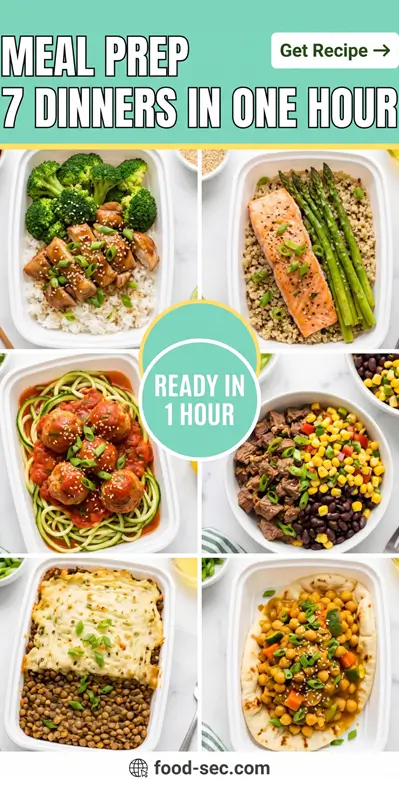
With a solid step-by-step meal prep system, you can have 7 complete dinners ready and waiting — all prepped in roughly one hour on a single day. No scrambling. No last-minute panic. Just open the fridge, reheat, and eat.
This guide will walk you through exactly how to do it, from planning your menu to storing everything correctly. Whether you’re a total beginner or just looking to get more organized, you’ll have a system you can actually stick to by the time you’re done reading.
What Is Meal Prepping and Why Does It Actually Work?
Meal prepping is the practice of preparing components or full meals ahead of time — usually done once or twice a week — so that cooking during busy weeknights becomes fast and stress-free.
In a nutshell: you do the “thinking and chopping” work upfront, so future-you just has to reheat and plate.
Studies show that people who meal prep tend to eat healthier, spend less money on food, and reduce food waste significantly. A 2017 study published in the International Journal of Behavioral Nutrition and Physical Activity found that meal planning was associated with a healthier overall diet and less obesity.
But beyond the stats, the real magic is this: you make decisions when you have time and energy, not when you’re hungry and tired. That alone changes everything.
What You Need Before You Start (The Setup Phase)
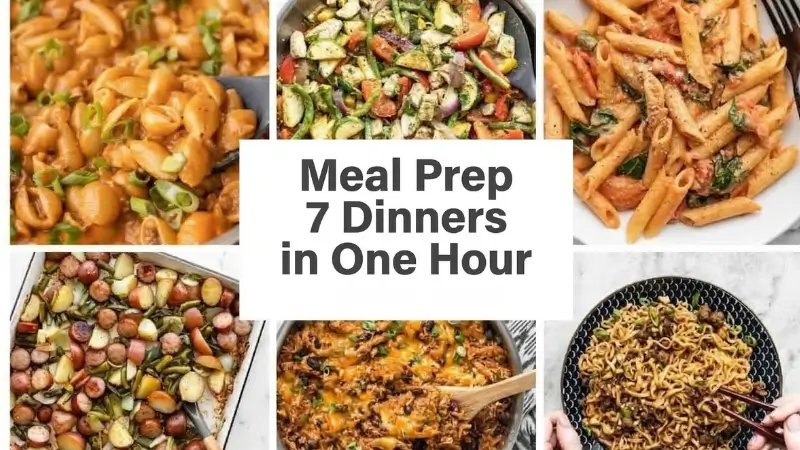
Before you even look at a recipe, spend 10 minutes getting organized. This is where most people skip a step and end up wasting time at the stove.
Here’s what to have ready:
- A written menu — know all 7 dinners before you shop
- Containers — enough airtight containers or meal prep boxes for 7 meals
- A sharp knife and a large cutting board — this will be your best friend
- Two to three sheet pans — for oven-roasting multiple proteins and veggies at once
- A large pot or Dutch oven — for grains, soups, or one-pot meals
If you’re just getting started with dinner prep, you might also want to check out this step-by-step guide to meal prepping dinner for the entire week for a deeper breakdown of containers, tools, and planning strategies.
How to Plan 7 Dinners Without Overwhelm
Step 1: Pick a Protein Anchor for Each Night
Don’t start with recipes — start with proteins. This simplifies everything.
For 7 nights, you might choose:
- 2 nights chicken breast or thighs
- 2 nights ground beef or turkey
- 1 night salmon or shrimp
- 1 night eggs or tofu (budget/veggie night)
- 1 night a hearty bean or lentil dish
Once your proteins are set, building meals around them takes minutes.
Step 2: Choose Shared Sides to Save Time
Here’s the shortcut most people miss: you don’t need 7 completely different meals. You need 7 satisfying dinners — and those can share components.
For example:
- Cook a big batch of rice → use it with Monday’s teriyaki chicken AND Wednesday’s stir-fry
- Roast two trays of vegetables → pair with Tuesday’s salmon AND Thursday’s grain bowl
- Make one pot of pasta sauce → serve with noodles one night and stuffed peppers another
This “component cooking” approach is what makes the 1-hour goal realistic.
Step 3: Write Out Your 7-Day Dinner Menu
Once you have your proteins and shared sides, your menu writes itself. Here’s a sample week:
| Day | Dinner | Shared Component |
| Monday | Teriyaki Chicken + Rice | Rice batch |
| Tuesday | Garlic Salmon + Roasted Veggies | Veggie tray |
| Wednesday | Beef Stir-Fry + Rice | Rice batch |
| Thursday | Veggie Grain Bowl | Roasted veggies |
| Friday | Baked Pasta with Meat Sauce | Pasta sauce |
| Saturday | Stuffed Peppers | Pasta sauce |
| Sunday | Lemon Herb Chicken + Fresh Salad | New cook |
Notice how rice appears twice, roasted veggies appear twice, and pasta sauce fuels two completely different dinners. That’s strategic batch cooking.
The 1-Hour Meal Prep Timeline (Step-by-Step)
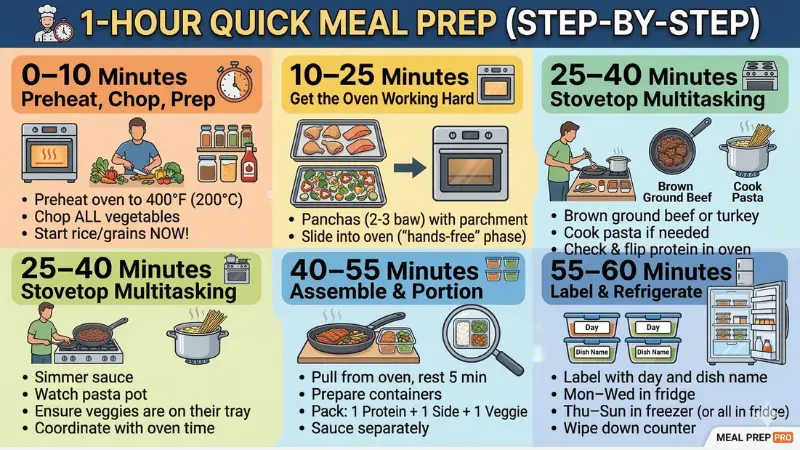
This is the core of the whole guide. Follow this sequence and you’ll be amazed at what you can accomplish in 60 minutes.
Minutes 0–10: Preheat, Chop, and Set Up
- Preheat your oven to 400°F (200°C)
- Wash and chop ALL vegetables at once — don’t stop to cook mid-chop
- Season your proteins (marinades, dry rubs, or simple salt + pepper)
- Start your rice or grain cooker NOW so it runs in the background
Minutes 10–25: Get the Oven Working Hard
- Line 2–3 sheet pans with parchment
- Spread proteins on one pan (chicken thighs, salmon fillets)
- Spread vegetables on another (broccoli, bell peppers, zucchini, sweet potato)
- Slide everything into the oven — this is your “hands-free” phase
While the oven runs, move to the stovetop.
Minutes 25–40: Stovetop Multitasking
- Brown ground beef or turkey in a large skillet
- Add sauce (marinara, taco seasoning, teriyaki) and let it simmer
- In a second pot, cook pasta if needed
- Check the oven and flip proteins if required
Minutes 40–55: Assemble and Portion
- Pull everything from the oven and let it rest for 5 minutes
- Open your containers and start portioning
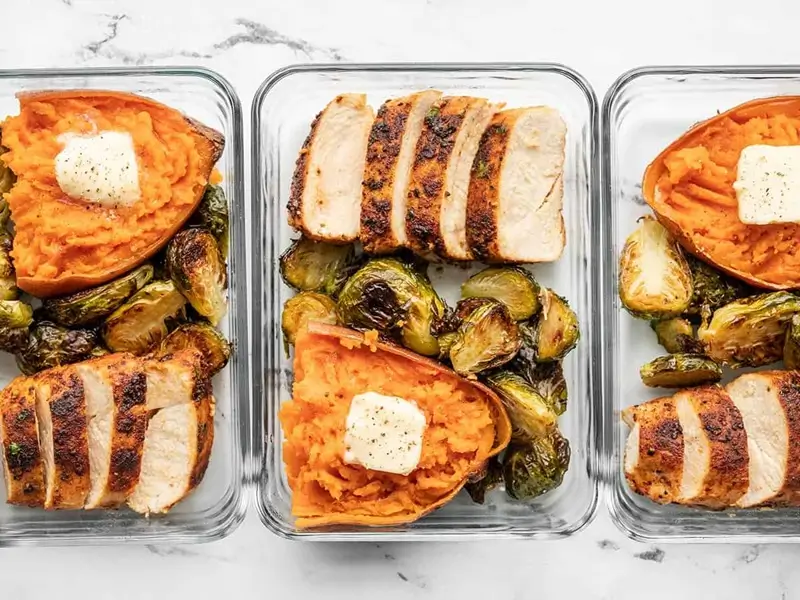
- Pack each meal with: 1 protein + 1 side + 1 veggie
- Sauce separately when possible (prevents sogginess)
Minutes 55–60: Label and Refrigerate
- Label every container with the day and dish name
- Place meals for Mon–Wed in the refrigerator
- Freeze meals for Thu–Sun (or keep all in fridge if you prefer)
- Wipe down your workspace — done!
7 Easy Dinner Ideas That Are Perfect for Batch Cooking
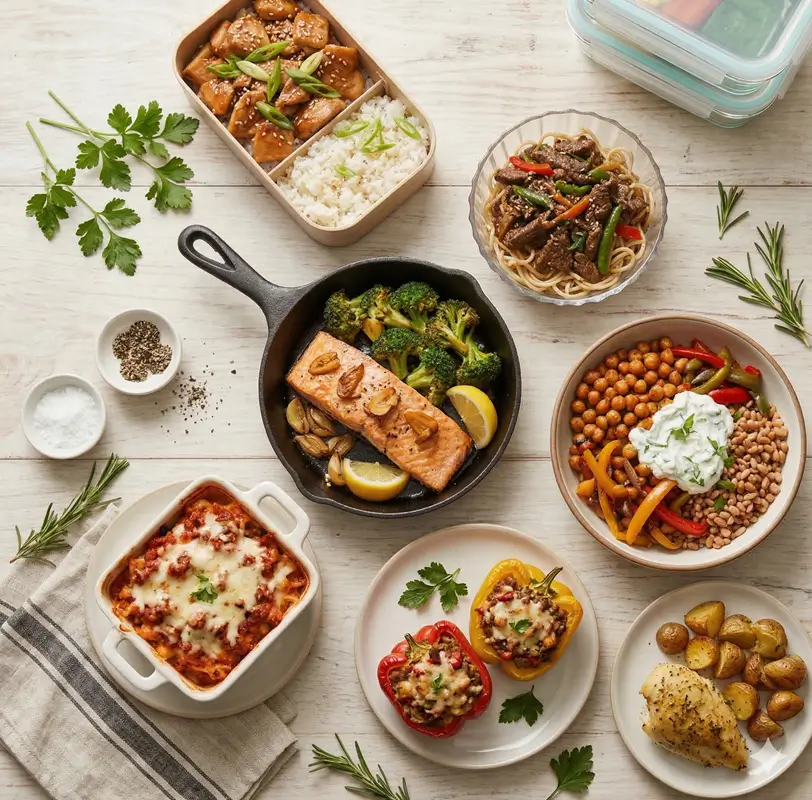
Not sure what to actually cook? Here are 7 dinners that hold up beautifully when prepped ahead of time.
1. Sheet Pan Teriyaki Chicken + Rice
Marinate chicken thighs overnight. Bake at 400°F for 25 minutes. Serve over rice with sesame seeds and green onion. Reheats perfectly.
2. Garlic Baked Salmon + Roasted Broccoli
Season salmon with olive oil, garlic, and lemon. Bake alongside broccoli. Ready in 20 minutes. One of the easiest high-protein meals you can prep.
3. Beef and Veggie Stir-Fry
Brown ground beef with soy sauce, ginger, and garlic. Toss with any vegetables you have. Serve over rice or noodles. Meal-preps like a dream.
If you love quick and satisfying dishes like this, the Garlic Steak Tortellini skillet dinner is a 30-minute option that’s absolutely worth adding to your rotation.
4. Mediterranean Veggie Grain Bowl
Roast chickpeas and veggies with olive oil and cumin. Serve over farro or quinoa with tzatziki sauce on the side. Light but filling.
5. Baked Pasta with Meat Sauce
Cook pasta halfway (it finishes in the oven). Mix with meat sauce. Top with mozzarella. Cover and bake. Serves a crowd and reheats better than you’d expect.
6. Stuffed Bell Peppers
Use leftover meat sauce from the pasta night. Stuff into halved peppers, top with cheese, bake 20 minutes. Practically free to make.
7. Lemon Herb Baked Chicken
A simple but deeply satisfying dinner. Coat chicken breasts in lemon juice, olive oil, garlic, and Italian herbs. Bake until golden. Works as a fresh Sunday dinner or the start of next week’s prep.
For more ideas that cook fast without compromising flavor, this collection of 40 quick and easy dinner recipes is a great bookmark to keep handy.
How to Store Meal Prepped Dinners the Right Way
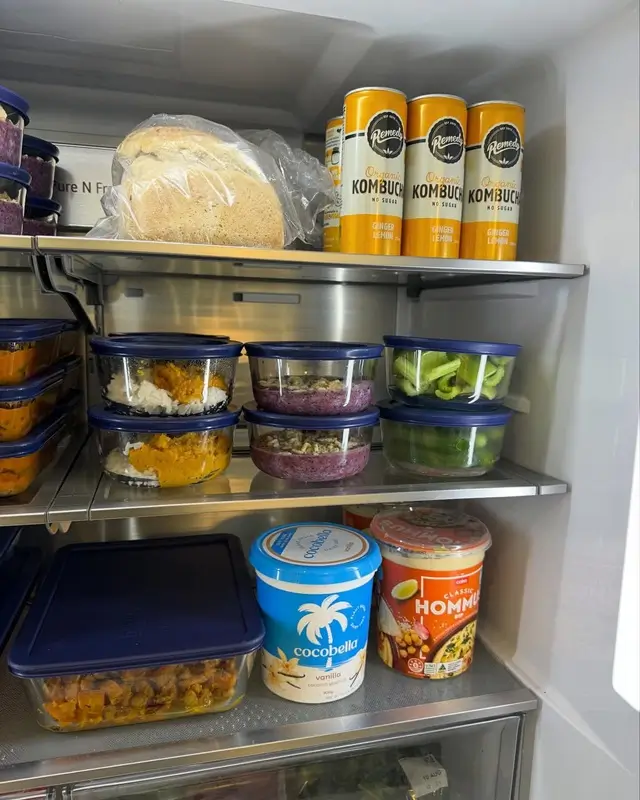
Good meal prep storage is what separates a week of delicious meals from a week of disappointing ones.
Refrigerator rule: Most prepped dinners last 3–4 days in airtight containers. Meals for Monday through Wednesday go straight in the fridge.
Freezer rule: Meals for day 4 through 7 should be frozen — unless you know you’ll eat them within 4 days. Freeze in single-serving containers so you can thaw only what you need.
Sauce separately: Store sauces and dressings in small separate containers. This keeps everything from getting soggy or over-saturated by day 3.
Cool before sealing: Let hot food cool for 20–30 minutes before snapping the lid. Trapping steam causes condensation and speeds up spoilage.
Meal Prep for Beginners: Common Mistakes to Avoid
Even with the best plan, beginners often hit the same walls. Here’s what to watch out for:
- Prepping too many different recipes at once. Start with 3–4 meals max on your first Sunday, then scale up as you get comfortable.
- Underestimating rice. A 2-cup dry rice batch yields about 6 cups cooked. That’s enough for 6–8 servings. Cook it once, use it all week.
- Not labeling containers. This sounds silly until you’re staring at four identical white containers at 6 PM and have no idea which one is beef and which is turkey.
- Skipping the freezer. Meals 5–7 of the week will lose quality if left in the fridge too long. Freeze them on prep day and move them to the fridge the night before.
- Using the wrong containers. Cheap containers warp in the microwave or leak in bags. Invest in a decent set of glass or BPA-free plastic containers — it’s worth it.
If you’re cooking for two instead of solo or family, you’ll want to scale accordingly. For nights when you want something special with less prep, these cozy dinner recipes for couples are a wonderful complement to your weekly routine.
How to Scale This System for Different Households
Solo cooker: Half the portions, same timeline. You can realistically prep 7 complete individual dinners in under an hour.
Couples: Double proteins, keep one shared side. Consider alternating between proteins each week to avoid taste fatigue.
Family of 4+: Use bigger sheet pans, a larger rice cooker, and a 12-inch skillet. You may need 75–90 minutes instead of 60, but the system stays the same.
Budget-conscious households: Ground meat, canned beans, eggs, and rice are your power players. You can prep 7 solid dinners for a family of 4 for under $50 if you plan smart. This guide to simple dinner recipes for college students has some excellent budget-friendly ideas that scale up perfectly.
Conclusion
Meal prepping 7 dinners in one hour isn’t about being a professional chef or having fancy equipment. It’s about working smarter, not harder — batching your cooking so your future self can just relax and eat well.
The key is in the system: plan shared components, anchor your week around proteins, use your oven and stovetop at the same time, and store everything correctly.
Start small if you need to. Try 3 dinners on your first prep day. Get comfortable with the rhythm. Then scale up to 5, then 7. Within a few weeks, Sunday meal prep will feel like second nature — and your weeknight stress will drop noticeably.
You’ve got this.
FAQ
1. What does “step-by-step meal prep” actually mean for beginners? Step-by-step meal prep means organizing your cooking into a clear sequence — planning, shopping, prepping, and cooking in a logical order. For beginners, it means breaking down the process so nothing feels overwhelming. You handle one task at a time rather than trying to do everything at once.
2. Can I really meal prep 7 dinners in 1 hour? Yes — if you use shared components and work in parallel. The secret is cooking multiple things simultaneously: proteins in the oven, grains on the stove, and sauces on a second burner. With a clear plan, 60 minutes is very achievable, especially after your first or second attempt.
3. How long do meal prepped dinners stay fresh in the fridge? Most fully cooked dinner meals last 3–4 days in the refrigerator when stored in airtight containers. For a 7-day plan, it’s best to refrigerate the first 3–4 meals and freeze the rest, moving frozen meals to the fridge the night before you need them.
4. What are the best meals for step-by-step meal prep during a busy week? The best meal prep dinners are those that reheat well without drying out or getting soggy. Great options include baked chicken, sheet pan salmon, rice bowls, stir-fries, baked pasta, and stuffed peppers. Avoid meals with delicate textures like crispy-fried items or fresh salads — those are better made fresh.
5. Do I need special equipment for meal prep dinners? You don’t need anything fancy. A sharp knife, two sheet pans, a large pot, a skillet, and a set of airtight containers are all you really need to start. A rice cooker is a helpful bonus since it frees up stovetop space, but it’s not required.